
Qi2.2 Travel Kit: The 2026 Carry-On Charging Guide
Executive Summary: The modern business trip has a charging problem that no amount of packing discipline solves: you carry three or four devices with sealed batteries, and the places you spend your time - a departure gate, a seat 30,000 feet up, a hotel room with one accessible socket behind the bed - were not designed to power any of them. The usual response is to pack more: a brick, three cables, a plug adapter, a power bank. That works, and it is why every travel bag eventually contains a tangled pouch nobody enjoys opening. Qi2.2 makes a genuinely lighter answer possible. With 637 certified products by February 2026 and fifteen handset models across four brands now carrying Qi2.2 certification, a single folding 25W magnetic surface can credibly serve every small device you travel with. This is a practical packing guide: what to carry, what to leave behind, and how to survive the four hardest charging environments in business travel - the Elecdov definition of Charge Calm.
Quick Navigation
Chapter 1: What Actually Changed for Travellers in 2026
Travel charging advice aged badly for years because the underlying technology barely moved. For most of the 2010s the correct answer was the same: bring a multi-port brick, bring a cable for every device, and bring a power bank because you will not find a socket when you need one. Wireless charging existed but was too slow to matter on the road, where charging windows are short and unpredictable.
Two changes have made that advice obsolete. First, the Wireless Power Consortium lifted the magnetic wireless ceiling to 25W with Qi2.2, and began certification in July 2025 under the v2.2.1 revision branded as Qi2 25W. The first officially certified product arrived that same month. Second - and this is the part that matters for travellers - Android joined properly. The Qi2 25W specification allowed non-Apple handsets to support 25W magnetic fast charging natively for the first time, which meant travel accessories stopped being an iPhone-only category.
The adoption numbers show how quickly that landed. Qi2.2 certified products went from 269 at the end of November 2025 to 342 in December, 521 in January 2026, and 637 by the end of February 2026. January alone contributed a record 181 new certifications. On the handset side, four brands and fifteen phone models now hold Qi2.2 certification, with Apple confirming that iPhone 17, iPhone 17 Pro and iPhone 17 Pro Max support the standard at up to 25W - matching the peak of its own magnetic system. Across the broader Qi2 family, 2,665 products were certified by the end of 2025 spanning twelve categories.
For packing, the consequence is concrete. When magnetic wireless was 15W, it was a supplementary convenience and you still packed cables for everything. At 25W it is fast enough to be the primary method for a phone, a watch and an earbud case, which means the cables become the backup rather than the plan. One folding surface plus one adapter replaces four objects. That is a meaningful reduction in a carry-on where every cubic centimetre is contested.

At 25W, magnetic wireless became fast enough to be the travel plan rather than the backup.
Q: Does this apply to Android, or is Qi2.2 still effectively an Apple standard?
A: It applies to Android now, and that is the significant shift. The Qi2 25W specification released in July 2025 was the first version to let Android handsets natively support 25W magnetic fast charging rather than relying on a case-mounted magnet ring. Fifteen phone models across four brands hold Qi2.2 certification as of mid-2026. That said, verify your specific model rather than assuming - certification is granted per handset, and within a single product family some models may be certified while others are still in process. A phone without a built-in magnet array will still work on a magnetic pad, but only with a magnetic case to handle alignment.
Chapter 2: The Carry-On Rule - One Folding Surface, Not Three Bricks
Good packing is subtractive. The question is never what else could be useful; it is what can be removed without creating a failure mode. Charging gear responds well to that discipline because most travel kits contain heavy redundancy that nobody has audited in years.
Empty the pouch and count. A typical business traveller carries a multi-port wall adapter, a USB-C cable for the phone, a proprietary cable or puck for the watch, a second short cable for the earbud case, an international plug adapter, and often a power bank with its own cable. That is six or seven items serving four devices. Every one of them is a thing to lose, and cables in particular fail at the worst moments - the Wireless Power Consortium has repeatedly identified worn cables and damaged charging ports as leading causes of smartphone quality complaints, which is precisely what thousands of hotel-room plug cycles produce.
The consolidated kit is three items: a folding magnetic charging station, one USB-C PD wall adapter rated at 30W or above, and one plug adapter if you are crossing regions. The Elecdov W103S is built for exactly this - a foldable three-in-one magnetic station that opens to charge a phone, a watch and earbuds together and collapses flat enough to sit in a laptop sleeve. For travellers who want the absolute minimum, the CE19A occupies a similar role in the Apple line as a compact desktop hub that carries well. Elecdov splits its Apple, Samsung and Google collections into Car, Desktop and Travel Charger series specifically so the travel variants are identifiable without reading every specification sheet.
Keep exactly one cable as insurance, not as the plan. A single 100W-rated USB-C to USB-C cable covers a laptop, charges the phone directly if a wireless surface is somehow unusable, and takes almost no space. What you are removing is the watch puck, the earbud cable, the second phone cable and usually the power bank - because a device that arrives at the gate at 95% rarely needs one. That is four items gone for the cost of a folding pad the size of a passport.

Three items replace seven: a folding magnetic station, one PD adapter, one insurance cable.
Q: Should I still bring a power bank?
A: For most business trips, no - and this is where the biggest weight saving hides. Power banks solve a problem created by arriving at a gate with a half-empty phone. If a folding magnetic station lets you top up during breakfast, in the lounge and at the hotel desk, the phone rarely drops low enough to need one. Bring a power bank when the itinerary genuinely justifies it: long-haul with no in-seat power, multi-day travel without reliable room access, or field work away from buildings. If you do carry one, choose a magnetic Qi2-certified model so it joins the same ecosystem rather than adding another cable. Also check the airline rules for your route, since carriers have tightened in-flight power bank policies and requirements now vary by operator.
Chapter 3: Airports and Lounges - Charging on Borrowed Power
The airport is where a travel charging kit is tested, because you are working on infrastructure you do not control. Sockets are scarce, shared, frequently loose, and often positioned so that anything plugged in must be watched. A charging strategy that assumes a clean private outlet is a strategy that fails at gate B14.
Design around the constraint that you will have one socket and limited time. This is where a folding three-in-one earns its space: a single plug serves the phone, the watch and the earbuds simultaneously, so a 40-minute boarding delay tops up everything rather than forcing you to choose. Set the station up so the phone sits at a readable angle - the W103S and the CE19A both hold a phone upright rather than flat, which means the boarding notification stays visible while charging, and you are not repeatedly lifting the device off the pad and interrupting the charge cycle.
Lounges are easier but introduce a different failure: seat power is often 5V USB-A only, built into a table or armrest. A USB-A port cannot negotiate the Power Delivery contract a 25W magnetic pad needs, so plugging your station into one will produce trickle charging and a confusing result. Carry your own wall adapter and use the mains socket rather than the convenient built-in USB port. This single habit resolves the majority of "my charger stopped working in the lounge" complaints.
Two more airport-specific notes. First, security screening is smoother when charging gear is consolidated - a single folding unit in an outside pocket is faster to present than a pouch of loose cables and bricks, which occasionally triggers a bag check. Second, magnetic alignment is genuinely valuable in a busy terminal: you place the phone without looking, it snaps into position, and charging starts at full efficiency rather than the degraded rate a misaligned flat pad delivers when you are distracted by a gate change.
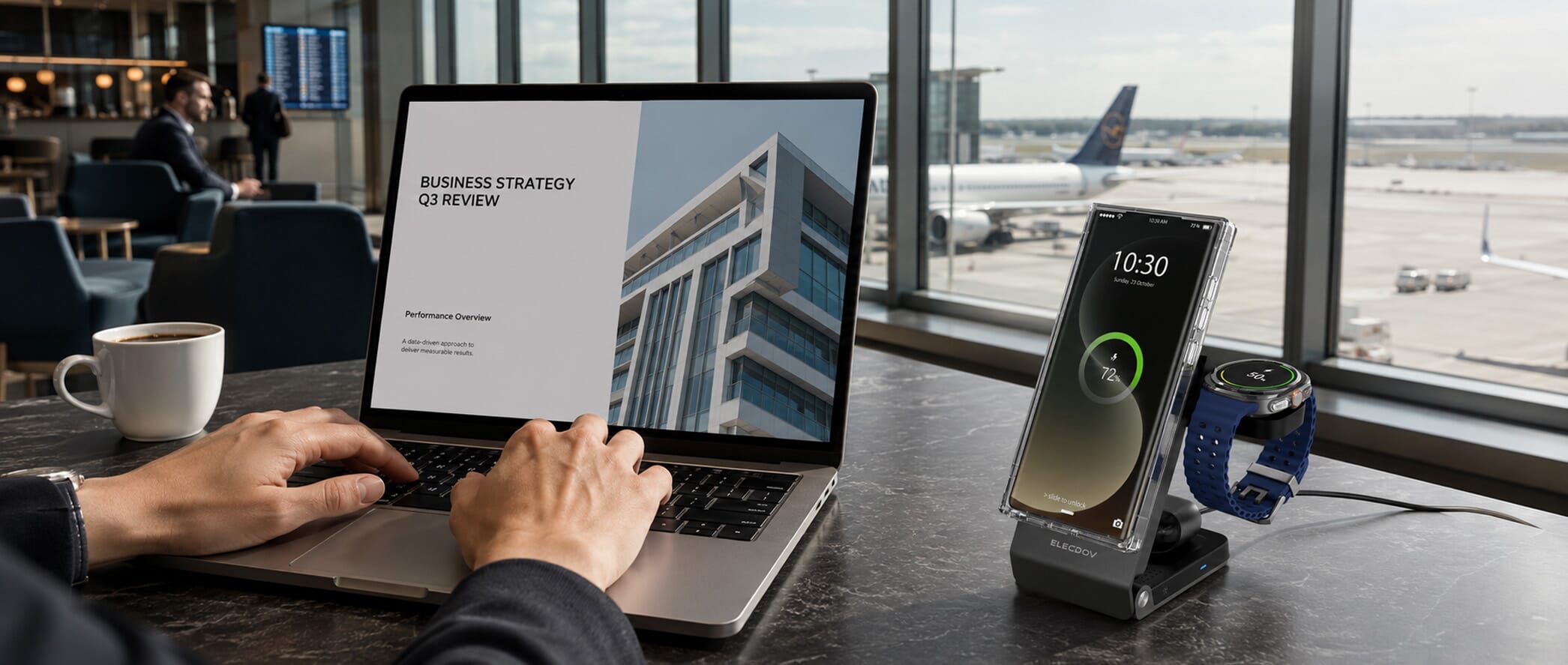
One socket, one folding station, three devices - the airport constraint solved by consolidation.
Q: The USB port in my lounge seat charges my phone but not my charging station. Why?
A: Almost certainly because it is a legacy USB-A port limited to 5V. Your phone accepts 5V happily and charges slowly. A 25W magnetic station needs a USB-C Power Delivery source capable of a 9V or 15V rail to reach its rated output, and many will refuse to enter high-power mode entirely rather than run in a degraded state. The fix is to use your own PD wall adapter in the mains socket. Built-in furniture USB ports are convenient but are usually the oldest and lowest-specified power source in the room.
Chapter 4: In-Flight and Hotel Rooms - The Two Hardest Sockets
These two environments defeat more travel charging setups than everywhere else combined, and for opposite reasons. In the air the problem is a power supply that is weak, intermittent and shared. In a hotel the problem is that the sockets exist but are in the wrong place.
In-seat aircraft power is the more constrained of the two. Where it exists, it is often limited well below what a laptop wants, and it can cut out during taxi, takeoff and turbulence. Some seats provide only a USB-A port with the same 5V limitation as a lounge table. Plan for degraded conditions: charge to full before boarding, then treat in-flight power as a bonus. A compact magnetic pad works well on a tray table precisely because the magnet holds the phone in place through turbulence, where a flat pad slides and silently stops charging. Fold the station to its single-device configuration if space is tight - the tray table is not the place to deploy a full three-device layout.
Hotel rooms are a geometry problem. The accessible socket is behind the desk or beside the television, and the bedside table has none, so the phone spends the night on the floor or nowhere. A folding magnetic station changes the calculation because it needs one socket and occupies a footprint smaller than a paperback: put it on the desk with the phone upright and the watch alongside, and you have a functional nightstand wherever the socket happens to be. Units with a clock display are particularly useful here, since the hotel alarm clock is invariably set to the wrong time zone and nobody wants to trust it.
The recurring theme is that both environments punish complexity. Anything requiring three plugs, a specific orientation, or a cable run across a room will not survive the trip. A single magnetic surface that works identically at the gate, on the tray table and on a hotel desk is the only configuration that stays in use for the whole journey. Elecdov designs the W103S and CE19A around that constraint, and backs both with an 18-month warranty and 30-day risk-free returns, with delivery in two to five days across the US and Europe from twelve overseas warehouses.

Magnetic hold matters most where surfaces move - a tray table punishes anything that slides.
Q: Is wireless charging on a plane a waste of the limited in-seat power?
A: It is slightly less efficient than a direct cable, which is a fair objection when the supply is weak. But the practical comparison is not efficiency, it is whether charging happens at all. A cable on a tray table gets snagged by a passing trolley or pulled loose when the seat in front reclines; a magnetic pad holds position. If the seat power is genuinely marginal, the right move is to use your one insurance cable directly and keep the pad packed. Arriving with a full charge before boarding remains the strategy that makes this question unimportant.
Chapter 5: The Pre-Flight Checklist
Everything above collapses into a short routine performed the night before departure. It takes under five minutes and eliminates nearly every charging failure that occurs on the road.
Verify certification before the trip, not during it. Confirm your charging station carries a genuine Qi ID and states Qi2.2 or Qi2 25W rather than the looser "Qi2 compatible". With 637 certified products available by February 2026 there is no reason to travel with something unverified, and a foreign hotel room is the worst place to discover a pad handles foreign object detection badly.
Match the adapter to the destination and the station. Bring a USB-C PD adapter of 30W or more with a 15V rail, confirm it accepts 100-240V input for international travel, and pack a plug shape adapter rather than a voltage converter. Test the exact adapter-plus-station combination at home before packing; discovering that your travel adapter throttles the station is a five-minute fix at home and an unsolvable problem abroad.
Audit the pouch and remove the redundancy. Folding station, one PD adapter, one plug adapter, one 100W USB-C cable as insurance. Remove the watch puck, the earbud cable, the spare phone cable, and the power bank unless the itinerary specifically justifies it. If you are carrying a power bank, check your airline current policy, as in-flight restrictions on power banks have tightened and now vary by carrier.
Leave with everything full. The most effective travel charging strategy is still departing at 100%. A three-in-one station used the night before means phone, watch and earbuds all start the journey full, which converts every charging opportunity en route from a necessity into an optional top-up. That is the entire point of the kit: not to charge faster under pressure, but to remove the pressure. Elecdov chose the dove as its mascot for exactly this reason - quiet, unobtrusive technology that does its job and disappears. Charge Calm.

The most effective travel charging strategy is still leaving with every device full.
Q: What is the one item most business travellers should stop packing?
A: The proprietary smartwatch charging puck. It is small enough that nobody questions it, it is useless for every other device, and it is the single most commonly forgotten item in a hotel room - which then requires an expensive replacement or a dead watch for the rest of the trip. A three-in-one magnetic station absorbs that function entirely. The second candidate is the multi-port brick, which becomes redundant the moment one wireless surface serves three devices from a single compact PD adapter.
Conclusion: Pack the System, Not the Spares
Business travel charging has been solved by subtraction rather than by any single product. The old kit was built on an assumption that no longer holds - that wireless charging was too slow to be the plan, so every device needed its own cable and the bag needed to carry all of them. Qi2.2 removed that assumption. At 25W, one magnetic surface is fast enough to be the primary method for every small device you travel with, and the cables become insurance you rarely open.
The ecosystem is now deep enough to rely on. Qi2.2 certifications grew from 269 in November 2025 to 637 by the end of February 2026, with a record 181 added in January alone and 23 certified charging modules available to manufacturers by May 2026. Four handset brands and fifteen phone models carry Qi2.2 certification, including the iPhone 17 series at up to 25W, and the wider Qi2 family passed 2,665 certified products across twelve categories. The WPC itself counted 328 member companies in January 2026, 91% of them working on the Qi ecosystem.
Pack a folding magnetic station, one properly rated PD adapter, one plug adapter and one insurance cable. Verify the Qi ID before you leave. Use the mains socket rather than the built-in furniture USB port. Depart at 100%. Everything else is weight you are carrying for a problem you have already solved - and travelling lighter is the most literal expression of Charge Calm there is.
Key Takeaways
| Decision Point | Correct Specification | Common Mistake to Avoid |
|---|---|---|
| Core charging kit | Folding 3-in-1 magnetic station plus one 30W+ USB-C PD adapter | A multi-port brick with a separate cable for every device |
| Travel adapter | 100-240V input, USB-C PD with a 15V rail, tested with your station before packing | Assuming any USB-C adapter will drive a 25W magnetic pad at full speed |
| Lounge and seat power | Use the mains socket with your own adapter | Plugging the station into a built-in 5V USB-A furniture port |
| Power bank | Only when the itinerary justifies it; prefer a magnetic Qi2-certified model | Packing one by default and checking airline policy at the gate |
| Certification | Searchable Qi ID and explicit Qi2.2 / Qi2 25W wording | Travelling with an unverified pad labelled "Qi2 compatible" |
| Departure state | Phone, watch and earbuds all at 100% before leaving | Relying on finding power en route to recover from a low start |
Ready to Make the Switch?
Elecdov builds Qi2 magnetic charging for people who travel light. The W103S folds flat and charges a phone, watch and earbuds from one socket; the CE19A brings the same three-in-one convenience to Apple setups; the CE05S keeps Galaxy travel kits compact. Fire-resistant materials, precision alloys, drop and durability tested, and covered by an 18-month warranty with 30-day risk-free returns and 2-5 day delivery from twelve overseas warehouses. Charge Calm.
Shop Elecdov Qi2 Chargers


