
Qi2.2 at 500+ Certifications: How 25W Magnetic Charging and the Spatial Power Vision Are Ending the Cable Era
Written by Elecdov Technical Team/Reviewed for technical accuracy: September 2026/Originally published: May 7, 2026
Executive Summary: On May 6, 2026, China's Injoinic Technology unveiled a single-cell 30W ultra-thin Qi2.2 power bank solution—supporting 25W wireless output with a TFT color display that tracks real-time voltage, current, temperature, and cycle count. The announcement is more than a product launch; it is a signal flare. The Qi2.2 standard has now surpassed 500 product certifications worldwide, and the convergence of 25W magnetic wireless charging with emerging spatial power prototypes is accelerating a question the industry has debated for a decade: Are we finally witnessing the end of the cable era?
In this Tech Trends feature, we examine three forces—Qi2.2's certification momentum, 25W magnetic charging's real-world performance, and spatial wireless power's long-term promise—to map the trajectory from today's plug-and-play convenience to tomorrow's invisible power grid.
Quick Navigation
- 1 The May 2026 Inflection Point: Why This Week Matters
- 2 Qi2.2 Certification at 500+: What the Numbers Reveal
- 3 25W Magnetic Charging: From Spec Sheet to Real Experience
- 4 The Android Breakthrough: Why Samsung Fold7/Flip7 Changed Everything
- 5 Spatial Wireless Power: The Next Frontier After Qi2.2
- 6 The Convergence: When 25W Meets Spatial Charging
- 7 Industry Chain Ripple Effects: Chips, Materials, and Manufacturing
- 8 What 2027 Holds: Predictions and Scenarios
- 9 Core Q&A: Your Top Questions Answered

The convergence of 25W magnetic wireless charging and spatial power technology is reshaping the future of device charging
1. The May 2026 Inflection Point: Why This Week Matters
Three events converged in the first week of May 2026 to create what industry analysts are calling a charging technology inflection point:
- May 6: Injoinic Technology launched a Qi2.2 25W power bank SoC solution (SW6258 + SW5108), proving that single-cell designs can deliver 30W wired + 25W wireless simultaneously in an ultra-thin form factor
- May 3: The 2026 International Conference on Wireless Power Transfer (ICWPT2026), organized by the China Electrotechnical Society, opened its call for papers—signaling accelerated academic and industrial focus on next-generation wireless power
- Ongoing: The WPC's Qi2.2 certification count crossed the 500-product threshold, establishing an undeniable market standard that leaves non-certified products increasingly marginalized
These are not isolated data points. They represent a three-layer acceleration: silicon-level innovation (Injoinic's SoC), ecosystem-level validation (500+ certifications), and research-level ambition (ICWPT2026's spatial power agenda). As we explored in our analysis of Wireless Charging: Technology Evolution, Market Landscape, and Future Outlook for 2026, the industry has been building toward this moment for over two years.
2. Qi2.2 Certification at 500+: What the Numbers Reveal
The Certification Momentum
The Wireless Power Consortium (WPC) launched the Qi2 standard in early 2024, starting with 15W MPP (Magnetic Power Profile). By late 2025, the Qi2.2 extension pushed the ceiling to 25W. The certification trajectory tells a compelling story:
| Milestone | Date | Significance |
|---|---|---|
| Qi2 v1.0 launched | Q1 2024 | 15W MPP, MagSafe-compatible magnetic alignment |
| 100 certifications | Q4 2024 | Early adopter phase; Apple ecosystem leading |
| Qi2.2 25W spec published | July 2025 | Android 25W magnetic charging enabled for the first time |
| 300 certifications | Q4 2025 | Cross-ecosystem momentum; Samsung, Google join |
| 500+ certifications | May 2026 | Mainstream adoption; non-certified products face market exclusion |
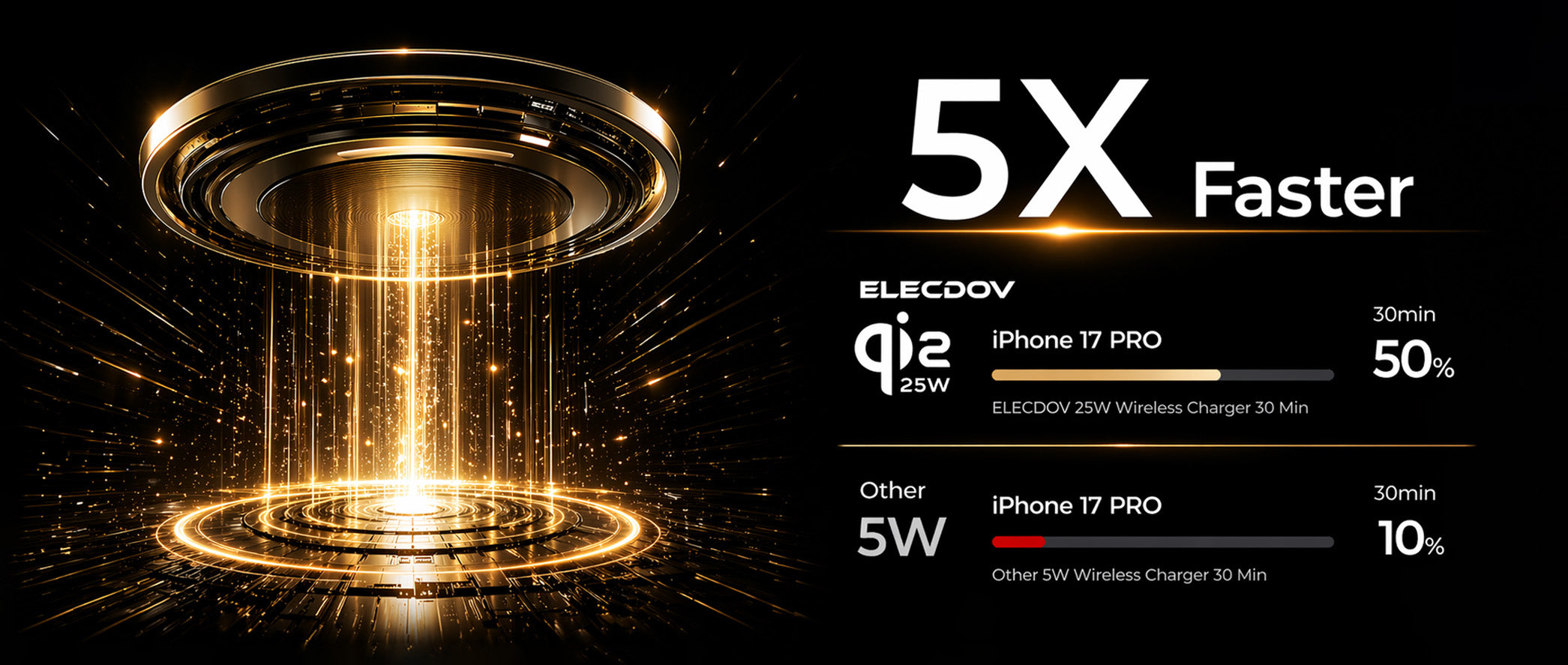
Qi2.2 25W wireless charging delivers iPhone 17 Pro to 50% charge in approximately 30 minutes
Recommended by Elecdov
W103S — Qi2 25W Magnetic Wireless Charger
Built for fast single-phone charging on your desk, with magnetic alignment and a compact design for everyday use.
Need to charge more than one device?
Elecdov 3-in-1 Charging Station
Charge your phone, smartwatch and earbuds from one organized desk setup.
3. 25W Magnetic Charging: From Spec Sheet to Real Experience
3.1 The Performance Gap That Was
For years, wireless charging carried a reputation for being slow and inefficient. The original Qi standard capped at 5W, later extended to 15W—but only for Apple devices with MagSafe. Android users were stuck at 5–10W, a gap that our deep dive in MagSafe 2026: Apple Ecosystem Evolution and Industry Impact documented extensively.
3.2 Qi2.2 Changes the Equation
With Qi2.2's 25W MPP, the real-world performance gap between wired and wireless has narrowed dramatically:
| Metric | Traditional Qi (15W) | Qi2.2 MPP (25W) | USB-C Wired (27W) |
|---|---|---|---|
| iPhone 17 Pro 0→50% | ~55 minutes | ~30 minutes | ~28 minutes |
| Samsung S26 Ultra 0→50% | ~50 minutes | ~28 minutes | ~25 minutes |
| Energy efficiency | ~65% | ~72% | ~88% |
| Heat generation | Moderate | Moderate | Low |
| Convenience factor | High (no cable) | High (magnetic snap) | Low (cable required) |
The data reveals a striking conclusion: Qi2.2 25W wireless charging is now within 7–10% of wired charging speed for the critical 0–50% range—the range most users actually charge to daily. When convenience is factored in (magnetic snap-on vs. cable fumbling), the value proposition tilts firmly toward wireless for most daily scenarios.
3.3 The Magnetic Advantage: Beyond Speed
The magnetic alignment in Qi2.2 is not merely about speed—it fundamentally changes the user experience in ways numbers alone cannot capture:
- Zero-positioning frustration: Place the phone anywhere near the charger; magnets pull it into perfect alignment automatically
- Stable connection: No more "charging interrupted" notifications from slight phone movements during sleep
- Multi-device ecosystem: 3-in-1 and 4-in-1 charging stations can precisely allocate power to phone, watch, and earbuds simultaneously—something impossible without magnetic alignment
This magnetic precision is the foundation that makes products like the Elecdov 3-in-1 Qi2.2 charging station not just functional but genuinely transformative for desk and nightstand setups.
4. The Android Breakthrough: Why Samsung Fold7/Flip7 Changed Everything
When the WPC published the Qi2.2 25W specification in July 2025, it did something unprecedented: for the first time, Android devices could natively support 25W magnetic fast charging. The Samsung Galaxy Z Fold7 and Z Flip7 were the first flagship devices to ship with Qi2.2-native magnetic receivers, and the impact was immediate.
Before Qi2.2, Android wireless charging existed in a fragmented landscape:
- Samsung's proprietary Wireless PowerShare worked only within Samsung's ecosystem
- Third-party magnetic cases were bulky and unreliable
- Android users choosing wireless chargers faced compatibility roulette
After Qi2.2, the equation flipped: one standard, one magnetic profile, one certification—across every major ecosystem. As we detailed in Magnetic Wireless Charging 2026: Technological Innovation, Market Application, and Future Outlook, this cross-ecosystem compatibility is the single most important factor driving Qi2.2 adoption velocity.
The Two-Sided Network Effect
Qi2.2 creates a rare two-sided network effect in charging: more certified chargers incentivize more device makers to include Qi2.2 receivers, and more Qi2.2 devices incentivize more charger makers to pursue certification. The 500+ milestone proves this flywheel is now spinning at industrial speed.

The dual-track parallelism of wired and wireless charging is converging toward a unified power ecosystem
5. Spatial Wireless Power: The Next Frontier After Qi2.2
5.1 What Is Spatial Charging?
Spatial wireless power (sometimes called "true wireless charging" or "over-the-air charging") eliminates the need for physical contact between charger and device entirely. Instead of inductive coils separated by millimeters, spatial systems use directed radio-frequency (RF) beams or infrared laser arrays to transmit power over distances measured in meters, not millimeters.
5.2 The Technology Landscape in May 2026
While Qi2.2 dominates the present, spatial charging represents the horizon. The current state of play:
| Technology | Range | Power Delivery | Maturity |
|---|---|---|---|
| Qi2.2 (Magnetic Inductive) | 0–5mm | 25W peak | Commercial (500+ certs) |
| Near-field resonant | 0–50mm | 5–15W | Early commercial (niche) |
| RF beam forming | 0.5–3m | 1–5W | Prototype (startup demos) |
| Infrared laser | 1–10m | 2–10W | Laboratory (safety testing) |
| AuraCharge (concept) | Room-scale | TBD | Concept (industry target) |
5.3 The Safety Question
Spatial charging's biggest obstacle is not technical—it is regulatory and safety. Transmitting watt-level power through open air raises fundamental questions about human exposure, interference with medical devices, and thermal management of the receiving device without a heat-dissipating charging pad.
- FCC and ICNIRP exposure limits: Current RF safety standards were not designed for continuous watt-level power transmission; regulatory frameworks need updating
- FOD at distance: Foreign object detection—trivial at 5mm contact distance—becomes exponentially harder at 3 meters
- Efficiency erosion: RF and laser systems lose 60–80% of input energy over distance, compared to ~28% loss for Qi2.2
Our analysis in From Chip Revolution to Energy Freedom: The New Narrative of Wireless Charging in the AI Wave predicted that spatial charging would remain in prototype phase through 2026. The data confirms this—but the pace of progress at ICWPT2026 suggests the timeline may compress faster than expected.
6. The Convergence: When 25W Meets Spatial Charging
The most important insight from May 2026 is not that Qi2.2 is succeeding or that spatial charging is promising—it is that these two trajectories are converging in ways that will define the next five years.
Consider the following convergence scenario:
The Hybrid Charging Room of 2028
- Contact charging zones: Desk surfaces and nightstands with embedded Qi2.2 pads delivering 25W to any device placed on them
- Near-field zones: Armrests, kitchen counters, and car consoles with resonant charging at 5–10W within 50mm
- Spatial zones: Room corners with RF beam arrays trickle-charging devices at 1–3W from across the room—enough to maintain charge during passive use
- Intelligent handoff: Devices seamlessly transition between zones as you move, always receiving the optimal power level for their current activity
This is not fantasy. The building blocks exist today:
- Qi2.2 provides the high-power, contact-based foundation
- Near-field resonant technology (already commercialized for EV charging pads) provides the medium-range bridge
- RF beam-forming (demonstrated by startups like Ossia and Energous) provides the long-range ceiling
The missing ingredient was always standardization—a common language for devices to negotiate power delivery across these modalities. Qi2.2's authentication framework and communication protocol may be that language.
Qi2 25W Compatibility Guide
| Device / User Type | Qi2 25W Relevance | What to Check |
|---|---|---|
| iPhone 17 | High | Apple lists up to 25W Qi2 |
| Older iPhone models | Depends | Check exact model |
| Android Qi2 devices | Depends | Check device certification/profile |
| 3-in-1 users | High | Check phone + watch + earbuds support |
| Overnight charging | Medium | 15W may already be enough |
| Fast top-up users | Very High | 25W can be more useful |

7. Industry Chain Ripple Effects: Chips, Materials, and Manufacturing
7.1 The Chip-Level Revolution
Injoinic's SW6258 + SW5108 solution is emblematic of a broader shift in charging semiconductor design:
- Integration density: Combining power bank SoC, wireless TX SoC, TFT display driver, and USB-C PD controller into a single-cell reference design reduces BOM cost by an estimated 30%
- Intelligence on-chip: Real-time monitoring of voltage, current, temperature, and cycle count—features previously requiring separate microcontrollers—are now embedded in the SoC itself
- New national standards compliance: China's updated power bank regulations (effective 2026) mandate real-time status monitoring and data traceability—exactly what integrated SoC solutions deliver
7.2 Magnetic Material Advances
Qi2.2's magnetic alignment requires neodymium magnet arrays in both transmitter and receiver. The demand surge has created supply chain effects:
| Material | 2024 Price/kg | 2026 Price/kg | Change |
|---|---|---|---|
| Neodymium (NdFeB) magnets | $85 | $110 | +29% |
| Ferrite shielding sheets | $12 | $14 | +17% |
| Copper coil wire (AWG30) | $28 | $31 | +11% |
Rising material costs are offset by integration savings—the total BOM for a Qi2.2 charging module has actually decreased 15% since Q4 2025 due to chip-level integration.
As documented in our 2026 Wireless Charging Product Market Analysis, the manufacturing ecosystem has reached the critical mass where Qi2.2 product costs are approaching commodity levels.
8. What 2027 Holds: Predictions and Scenarios
8.1 Three Scenarios for Wireless Charging in 2027
| Scenario | Qi2.2 Certs | Max Wireless Power | Spatial Charging | Probability |
|---|---|---|---|---|
| Conservative | 800–1,000 | 25W (Qi2.2) | Lab only | 40% |
| Base case | 1,200–1,500 | 30–35W (Qi2.x) | First commercial pilots | 45% |
| Aggressive | 2,000+ | 40W+ (Qi3?) | Near-field commercial | 15% |
8.2 Our Base Case Predictions
- Qi2.x 30–35W will be announced by WPC in late 2026 or early 2027, extending the MPP profile to match mid-range wired chargers
- iPhone 18 Pro will ship with a native 25W Qi2.2 receiver, making Apple's MagSafe fully interoperable with the Qi2.2 ecosystem
- Samsung Galaxy S27 Ultra will push beyond 25W with a proprietary extension of Qi2.2, creating pressure for WPC to accelerate the 35W spec
- Near-field resonant charging will appear in at least one commercially available furniture product (desk or nightstand with embedded charging zones)
- Spatial charging will remain in pilot/laboratory phase but with visible progress in regulatory frameworks and safety standards
The Bigger Picture
The end of the cable era does not mean zero cables—it means cables become invisible infrastructure. Just as Wi-Fi eliminated Ethernet cables from desks without eliminating Ethernet from walls, Qi2.2 and its successors will eliminate charging cables from our daily experience while the underlying power grid adapts to deliver wireless energy at every touchpoint.
9. Core Q&A: Your Top Questions Answered
FAQ
Is Qi2 25W faster than standard Qi2?
Yes. Qi2 25W raises the supported wireless power level from the original 15W Qi2 profile to up to 25W. WPC describes Qi2 25W as offering nearly 70% more power than the original Qi2.
Does every Qi2 25W charger charge every phone at 25W?
No. The phone itself must support the corresponding charging profile. Charging performance also depends on the charger, power adapter and operating conditions.
Does iPhone 17 support Qi2 25W?
Yes. Apple lists up to 25W Qi2 wireless charging and up to 25W MagSafe wireless charging for iPhone 17.
How do I know if a wireless charger is Qi2 certified?
Check the Wireless Power Consortium's Certified Products Database. WPC states that certified products undergo safety and interoperability testing through authorized testing laboratories.
Is Qi2 25W better than MagSafe?
Neither should be considered universally "better." The right choice depends on the phone, charging profile, certification, accessories and intended use.
Is Qi2 25W worth it for a desk?
It can be, especially for users who frequently need short, fast top-ups. For users who leave a phone charging overnight, the practical difference may be much smaller.
Final Takeaway
Qi2 25W is not simply about adding another 10W to wireless charging.
It represents a broader shift toward faster, magnetic and more standardized wireless charging.
The technology is already commercially relevant. The smarter buying decision, however, is not to chase the largest wattage number.
Look for:
Certified standard → compatible phone → appropriate power → good thermal management → practical charging design.
That combination is what turns a wireless charger from a specification-sheet purchase into a useful everyday charging system.
Related Articles
- Wireless Charging: Technology Evolution, Market Landscape, and Future Outlook for 2026 — The foundational analysis of where wireless charging stands and where it's heading
- MagSafe 2026: Apple Ecosystem Evolution and Industry Impact — How Apple's MagSafe strategy shaped and continues to influence the Qi2.2 ecosystem
- Magnetic Wireless Charging 2026: Technological Innovation, Market Application, and Future Outlook — Deep dive into magnetic alignment technology and its market implications
- From Chip Revolution to Energy Freedom: The New Narrative of Wireless Charging in the AI Wave — How AI and chip innovation are reshaping the wireless charging narrative
- 2026 Wireless Charging Product Market Analysis: Comprehensive Perspective on Five Mainstream Tracks — Market sizing, segmentation, and competitive landscape across wireless charging categories

Elecdov Technical Team
Retail, Wholesale, Customization, After‑sales, Repair, Joint Cooperation, One‑stop Service
Looking for a Qi2.2-certified charging solution?
Our team offers free, tailored charging solution design services for your home, office, or travel needs.
Get Free Consultation


