
After Galaxy Unpacked 2026: The Z Fold 8 Era Desk Setup & Qi2 25W Charging Guide
1. What Unpacked 2026 Announced — and Why Your Desk Cares
Samsung's summer Galaxy Unpacked (London, July 22, 2026) delivered its broadest foldable lineup yet: the Galaxy Z Fold 8 with a new wider 3:4 passport-style inner display, a first-ever Z Fold 8 Ultra, the Z Flip 8, plus Galaxy Watch 9 and Watch Ultra 2 (Samsung Newsroom / CNMO, July 22–23, 2026). The Fold 8 measures 4.5mm unfolded and 9.7mm folded — thin enough that owners will increasingly work directly on the device propped at their desk rather than reaching for a tablet.

Why does a phone launch matter to desk design? Because foldables change charging behavior. A book-style device docked upright becomes a genuine second screen for calendars, chats, and dashboards. Larger internal displays also draw more power during screen-on desk use, which means midday top-ups shift from optional to routine. If your charging spot is a loose cable behind the monitor, the new hardware generation will expose that weakness within a week.
2. Qi2 25W: The Standard Powering the Foldable Era
The timing of Unpacked is fitting: July 2026 is the first anniversary of Qi2 25W, branded from Qi v2.2.1 and launched by the Wireless Power Consortium in July 2025. WPC reports the certified ecosystem has passed 13,000 Qi Certified products, while Qi2 itself was enabled on over 1.5 billion wireless devices within its first year (Wireless Power Consortium, 2026). The 25W profile delivers nearly 70% more power than original Qi2 — enough to make wireless the primary desk charging method rather than the slow fallback.
The invisible half is interoperability. Certification guarantees magnetic alignment tolerances, foreign-object detection, and power negotiation that behave identically across every compliant phone — including cross-brand desks where a Galaxy foldable, a colleague's Pixel, and an iPhone rotate across the same station. For anyone standardizing a workstation (or a whole office) in 2026, buying certified Qi2 25W hardware is the single decision that future-proofs the rest.
Standard Comparison: What Changes at the Desk
| Capability | Qi Baseline/EPP | Qi2 (15W MPP) | Qi2 25W (Qi v2.2.1) |
|---|---|---|---|
| Max certified power | 5–15W | 15W | 25W |
| Magnetic self-alignment | No | Yes | Yes |
| Midday top-up viability | Poor | Acceptable | Strong — ~50% in about 30 min on supported phones |
| Energy efficiency | Position-dependent | High (aligned coils) | Highest per WPC test criteria |
| Desk role | Overnight pad | Convenience dock | Primary charging method |
Source: Wireless Power Consortium Qi2 25W media materials and certification documentation, 2025–2026.
3. Thermal Engineering: What Sustained 25W Really Requires
Peak wattage is a marketing number; sustained wattage is an engineering result. Delivering 25W continuously without throttling demands deliberate thermal design: separated charging zones with independent circuits, heat sinks isolated per coil, ventilated metal chassis, and firmware that regulates power against real-time temperature readings rather than fixed timers.
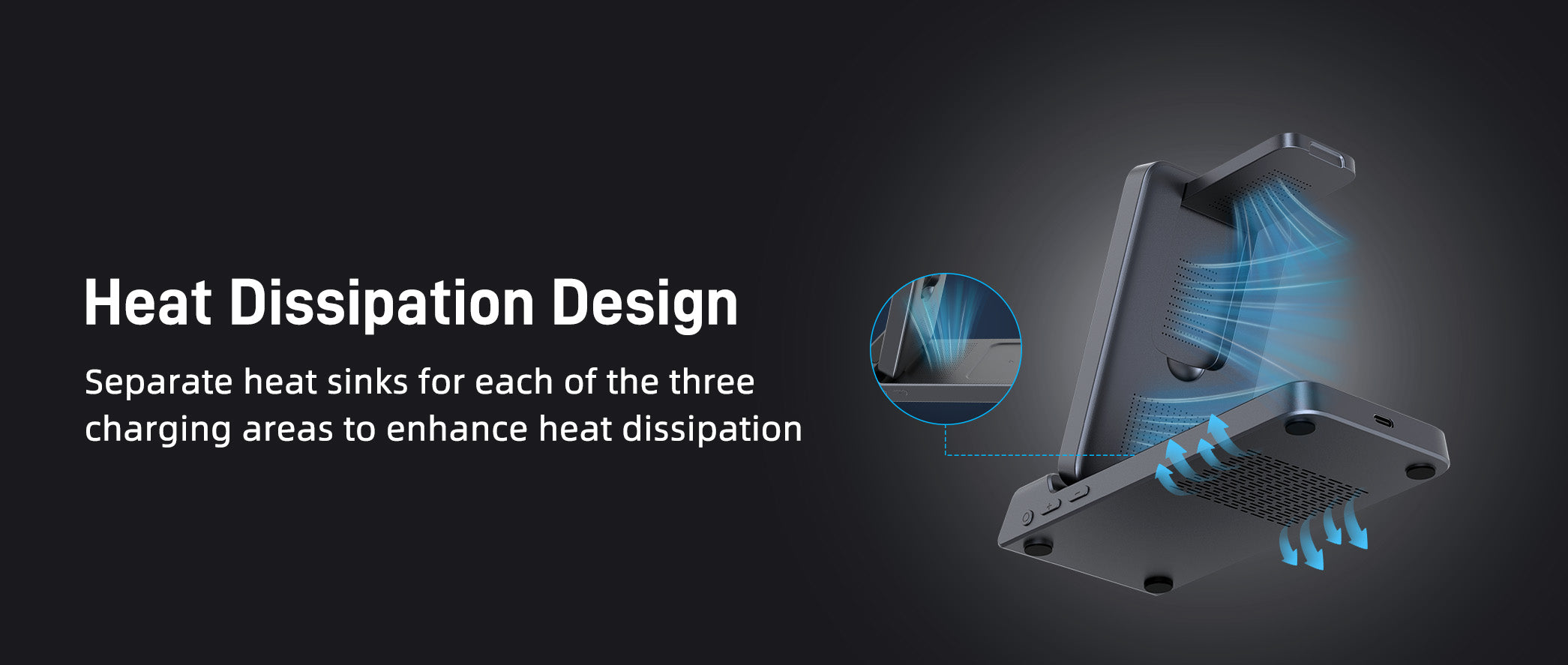
This matters doubly for foldables. A larger battery split across two cells, charging while the device runs a large screen, generates more combined heat at the desk than a slab phone did. Stations built with independent thermal circuits per zone prevent the classic failure mode where a hot phone zone drags down the watch and earbuds zones beside it. When you evaluate any 3-in-1 station, ask one question first: does each zone manage its own heat, or do all three share one thermal budget? The answer predicts real-world speed better than the wattage on the box. Certified foreign-object detection adds the final safety layer, cutting power instantly if keys or clips land on a coil.
4. The Three-Zone Desk Layout Blueprint
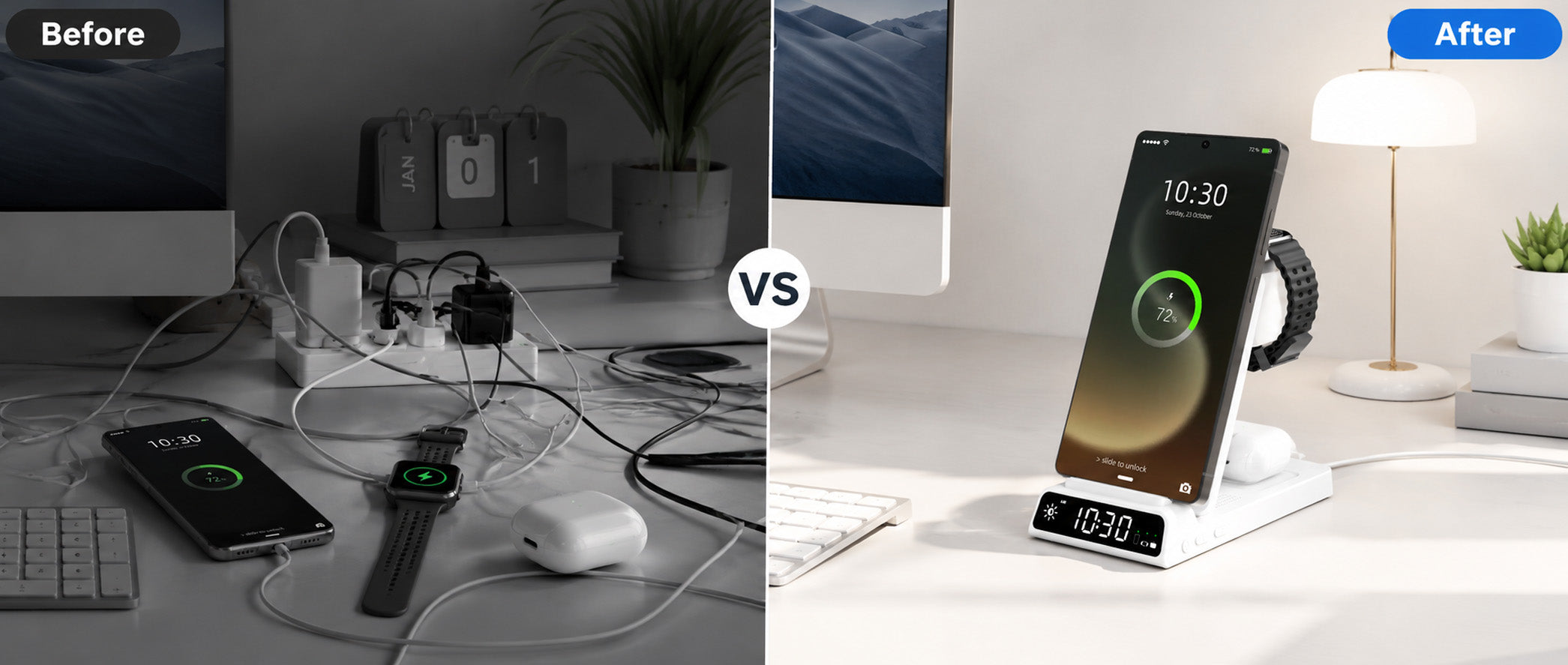
An effective 2026 desk assigns wireless charging a fixed address. The blueprint: place a 3-in-1 station in the "glance zone" — beside the monitor at 30–45 degrees from your sightline — so the docked foldable works as an ambient second display. Keep the keyboard-and-mouse zone completely cable-free, and route the station's single USB-C feed with your monitor cabling behind the desk.

Zone assignments follow device roles. The 25W fast zone belongs to the phone — it has the largest battery and the highest turnaround urgency before meetings. The 15W or mid zone suits earbuds cases and secondary devices. The 5W watch zone runs overnight logic: watches sip power, so their charge windows can be long and passive. One deliberate habit completes the system: dock the phone every time you sit down. With magnetic alignment there is no placement cost, and the battery simply stays between 60% and 90% all day — the healthiest band for long-term battery chemistry, according to widely cited IEEE battery-aging research.
Desk Charging Map by Device Type
| Device | Typical Battery | Assigned Zone | Charge Window | Desk Behavior |
|---|---|---|---|---|
| Foldable phone (Z Fold 8 class) | 4,400–5,000 mAh | 25W fast zone | Sit-down docking, all day | Upright, second-screen angle |
| Flip-style phone | 4,000–4,300 mAh | 25W fast zone | Midday top-up | Flex-mode clock/widgets |
| Smartwatch | 300–590 mAh | 5W watch zone | Lunch hour or overnight | Passive, low priority |
| Wireless earbuds | 500–700 mAh (case) | 5–15W pad zone | Between calls | Drop-and-forget |
5. Equipping Teams: Enterprise & Bulk Procurement
The week after a major Unpacked is when IT departments feel the change first: employees arrive with new foldables and watches, and meeting rooms, hot desks, and executive offices all need charging points that simply work for everyone. Standardizing on certified Qi2 25W stations solves compatibility once — and buying at fleet scale unlocks structured procurement support.

- Volume pricing from 10 units: escalating discount tiers from 10+ up to 500+ unit deployments.
- WPC Qi2.2 certification documentation: full compliance certificates, test reports, and WPC registration IDs included with every order — ready for IT compliance audits.
- Dedicated account manager: one contact covering quotation, lead times, delivery, and post-purchase support.
- Customization tiers: logo etching and branded packaging from 50+ units (3–4 weeks); Pantone color-matched housings from 200+ units (6–8 weeks); custom firmware — LED behavior, power policies, device identification — from 500+ units (12–16 weeks).
- Flexible delivery & warranty: split shipments across sites, phased delivery, blind shipping options, and 3- or 5-year extended warranty plans with advanced replacement.
Enterprise quotes: elecdov.com/pages/contact
Procurement leads report that the certification paperwork is the sleeper benefit: audit-ready WPC documentation shortens internal approval cycles that otherwise stall accessory rollouts for weeks.
6. Choosing Your Station: A Practical Shortlist
With the standard, thermals, and layout settled, selection reduces to matching a station to your desk's role. A primary workstation deserves the full three-zone flagship with an aluminum base and LED status indication. A design-forward desk can justify the carbon-fiber build for durability and heat dissipation. A shared or secondary desk favors configurable arm positions for rotating devices and cases of different sizes.
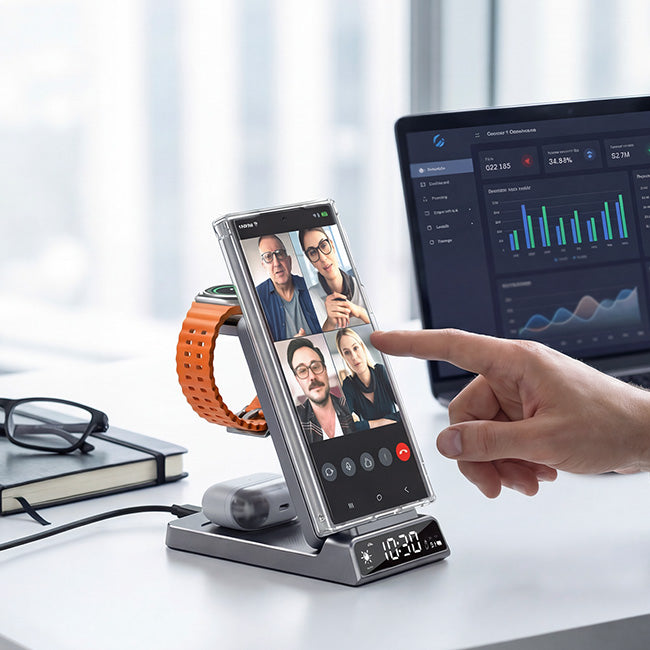
Whatever you choose, apply the same three filters: certified Qi2 25W output on the phone zone, independent thermal management per zone, and magnetic alignment strong enough to hold through a case. Those three filters eliminate most disappointments before they reach your desk — and they are exactly the criteria the recommendations below were selected against.
Frequently Asked Questions
Yes. Qi2 25W stations are backward compatible across Qi generations; each device negotiates its own supported power level automatically under WPC certification rules.
The protocol is identical, but docking posture matters more — an upright stand lets a folded device serve as a second screen, and certified magnetic alignment ensures the coil sits correctly despite the thicker folded profile.
Yes, within certification limits. Qi2 25W mandates thermal regulation and power negotiation, and keeping a docked phone in the 60–90% band during desk hours is gentler on battery chemistry than deep daily discharge cycles.
Three items: WPC certification documents (certificates, test reports, registration IDs), per-zone thermal design for all-day duty cycles, and warranty terms with advanced replacement for minimal desk downtime.
Magnet-ring-compatible cases up to roughly 3mm generally charge normally. Very thick, metal-plated, or wallet-style cases can weaken alignment and should be removed for fastest charging.
🔋 Elecdov Picks for the Z Fold 8 Era Desk
Elecdov CE20S — 3-in-1 Magnetic Charging Station for Samsung
The flagship desk anchor: 25W + 15W + 5W independent zones, aluminum alloy base, LED status indication, and FOD protection — built for executive and home-office desks running the new foldables.
Elecdov CE19S-CF — Carbon Fiber 3-in-1 Charging Station
The premium-durability option: carbon fiber housing with superior heat dissipation for heavy all-day charging cycles on design-forward desks.
Elecdov CE19S — Magnetic 3-in-1 Wireless Charger for Samsung
The balanced workhorse: three-zone charging with a built-in clock display, equally at home on a desk or nightstand.
Elecdov WC01A — 3-in-1 Magnetic Charging Station for iPhone
For mixed-ecosystem desks and households: keeps iPhone, Apple Watch, and AirPods covered so every seat in the office charges the same way.
Related Reading
- World Cup 2026 & Qi2.2 Wireless Charging: Power Your Passion
- Wireless Charging Technology Evolution: Market Landscape and Future Outlook for 2026
- Summer 2026 Travel Charging Guide: How Qi2.2 25W Magnetic Charging Is Transforming On-the-Go Power
The Elecdov Editorial Team covers wireless charging standards, desk ergonomics, and enterprise device deployment. Analysis in this article references Wireless Power Consortium (WPC) official releases, Samsung Newsroom launch materials, and IEEE-published battery research.


